CREATIVE PROCESS
Thoughts on Creativity and Process
Ideas are everywhere, in conversations, books, museums, beach walks and dreams. Translating ideas into shared images enables us to understand each other better and to express ourselves as individuals to our greater community.
The Infinite Mind
Moments of contemplation over coffee or stars helps manifest ideas in the mind, some would say in the third eye, “a ‘meta’ organ that consists of your mind and all of your senses working together as a larger, more powerful sensory organ,” Casey Kochmer, Opening the Third Eye. Magnesium Studio is about ideas and stories told through abstract surrealism. The studio harvests ideas, transforming them into images for others to learn from, react to, or simply enjoy. The process is contemplative where works are approached as meditations, blending intentional constructs with spontaneous composition of line and color to form symbolic images of depth and substance.
The Creative Mind
“If you believe human wants and needs are infinite,” said Andreesen, “then there are infinite industries to be created, infinite businesses to be started and infinite jobs to be done, and the only limiting factor is human imagination. The world is flattening and rising at the same time.”
“The World is Flat, “America and Free Trade”, page 231 Thomas Friedman, 2005
Within a lifetime the average person uses about one tenth of one per cent of the human brain’s capacity to store information and solve complex problems. The creative mind is a restless thing, always searching or wondering through the labyrinth of a mental entourage of places and objects that may hold the promise of the next great idea. Someone once said, “there are no new ideas, just a continuum of recombined and repackaged past ideas.” Where do new ideas come from? How can new ideas be found? How can the creative mind tap the vastness of the human brain to unlock and access the seemingly unlimited capacity and capability of an exploitable resource that we are all born with? Or are we all born with a creative mind?
In 1969 I stood before my third grade class and shared a vision for a small world I was creating on the wooded banks of a stagnant slew near Eugene, Oregon. My “show and tell” was all tell and realistically there was no show involved. But in my mind the world that I was creating with my friends was very real. While the tree house and other tree top platforms were in place, an entire master plan of bridges, paths vehicles and buildings were so vivid in my mind they had become my reality. Looking back, my teacher, while working with limited tangible information, was patient and allowed me to go on with my vision to an unbelieving classroom. However, I had invited enough of my classmates to the “fort” that I was able to preserve any credibility I had especially considering that I was nine years old. I can only imagine little Roald Dahl, Salvador Dali or Raymond Lowey describing weekend or summer activities to Monday morning classmates.
Robert Kostka, a protégé of Moholy Nagy, Josef Albers and Peter Selz of the New Bauhaus school of design in Chicago said, “we spend our entire childhood desperately trying to become adults and the rest of our lives trying to get back to our childhood.” His point was that by having the freedom of childhood thought enables unencumbered creative thinking. It is the simple ability to play that unlocks the endless possibilities of problem solving. Unlike mathematics, there can be endless answers to design problems. Finding a solution is much less important than finding the best solution to any design problem. Having the mental freedom to explore and play with possibilities can produce extraordinary results.
“When I asked Bill Gates about the supposed American education advantage – an education that stresses creativity, note rote learning – he was utterly dismissive. In his view, those who think that the more rote learning systems of China and Japan cant’t turn out innovations who can caompete with Americans are sadly mistaken. Said Gates, “I have never met a guy who dosen’t know how to multiply who created software… Who has the most creative video games in the world? Japan! I never met these rote people’ … Some of my best software developers are Japanese.”
“The World is Flat, “Dirty Little Secret #2: The Ambition Gap”, page 264, Thomas Friedman, 2005
Today, there is an unavoidable trap that many designers fall into. The trap of not designing but applying standards, standard details, standard systems, standard materials and standard everything leads to mediocre everything. Rarely does film, architecture, engineering, industrial design, graphic arts (clip art) fashion, planning, urban design and medical stuff produced from standards lead to the advancement of technology or the advancement of thought. Space exploration probably led to the greatest thinking and innovation since the industrial revolution maybe even since the Roman arch.
There is a fine line between innovation and creative design and free thinking where deadlines and clearly defined problems or needs are less important than creating a specific solution to a specific problem.
“At an early age children are weaned on the marvelous, and later on they fail to retain sufficient virginity of mind to thoroughly enjoy fairy tales.”
The Process
Life Experineces
Expressionist Surrealism
Symbolism
Color
Triad Concept
Story Line
Media
Meditation

THE CREATIVE ENGINE
Ideas, Inspiration and Processes
THOUGHTS in GENERAL
Artist statements, observations, opinions with random thoughts and poetry
Reverse Income Housing and
The World After Us
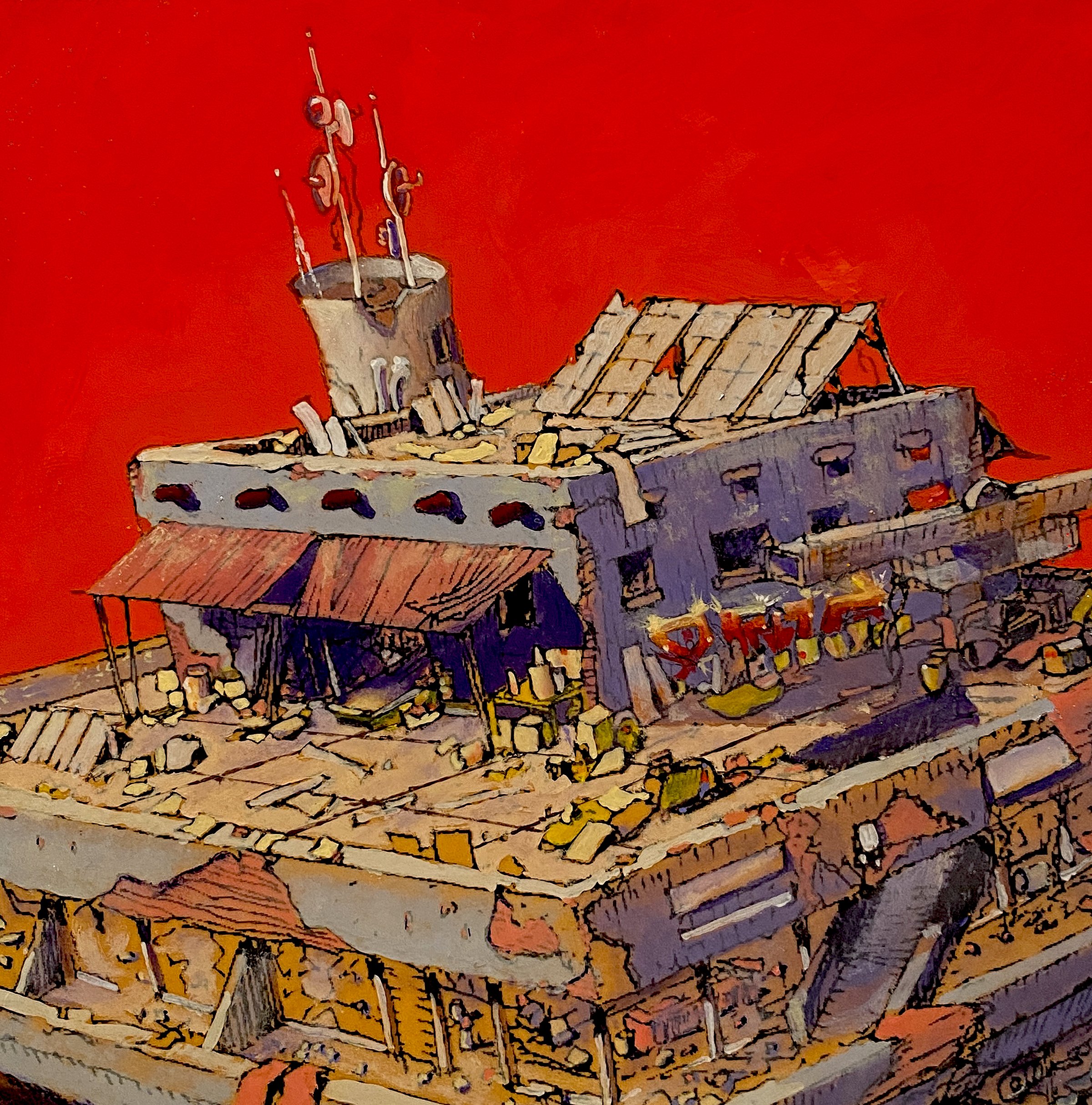
This exhibit is about a distant future, beyond several generations, and the remnants we leave behind. The work is inspired by and illustrates the surreal nature of the current affordable housing crisis in the US and the wasted resources of our time. In two parts, the work explores uncommon compositions of our common life – Reverse Income Housing and The World After Us.
Today,
· Over one third of Americans, 103 million of 342.6 million, rent in 44 million households. PEW Research Center
· Nearly half of US renters spend more than 30 percent of their income on rent. PEW Research Center
· About half of renting households are cost burdened. PEW Research Center
· The US ranks among the worst, boasting the highest share of renters who spend more than 50 percent of their income on housing, a rate worse than peers like Spain, UK and Australia. National Low Income Housing Coalition
· Recent estimates show the U.S. homeless population at roughly 745,000 to 771,000 individuals on a given night. H.U.D
Within the remnants of the unhoused, are examples of reverse income housing where surreal habitats are cobbled together from unrealized vacations.
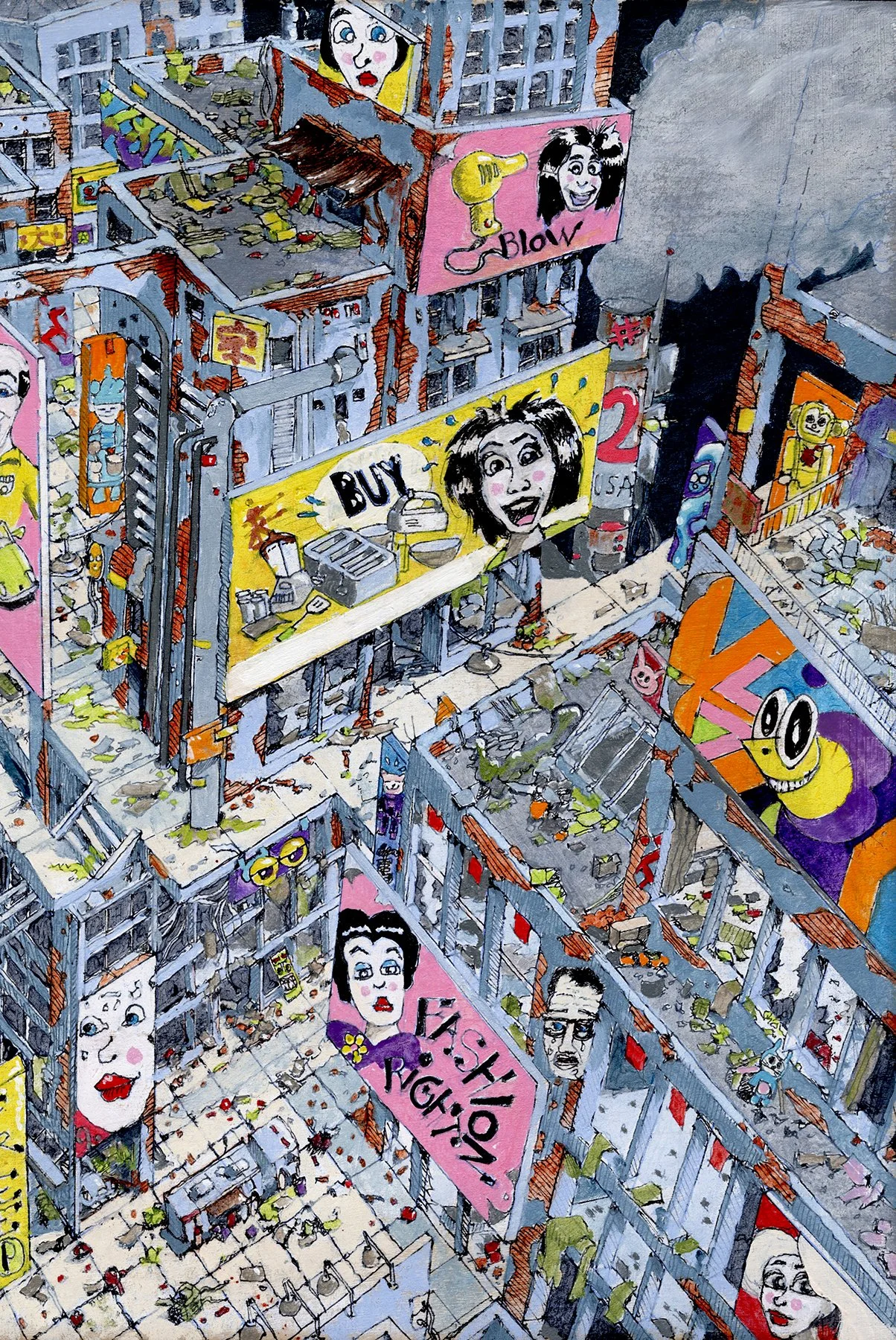
The World After Us, through drawings and paintings illustrate remnants of humanity, or what we leave behind in a time after human extinction. Our Anthropocene Epoch describes the era in which human activity has become the dominant influence on the Earth’s climate, ecosystems, and bio-geophysical processes. Based on current science, ignored pathogens, consumption, and disregard for signs of environmental decline, the American melting pot continues to boil and we are the frogs.
One example is ground level air that becomes unbreathable (Ozone build up), pushing industry and habitation higher and higher until it reaches the atmospheric ceiling where humanity falls. Human behavior adapts to reach for breathability. Manufacturing and consumption behavior neglects necessary changes to save humanity suffering irreversible, ever-decreasing air supply.
Beyond traditional media, brushes, pencils, ink and paper, the tools that help me create come in three forms. First, my physical environment provides fuel for my imagination. Forest paths, long expanses of beach, spindrift, and an ever-changing sky, provide a robust tool for color selection and composition. The calming coastal environment clears my head. On hikes, I make lots of photographs for resource files. These are tools to change the beat if I become stuck.
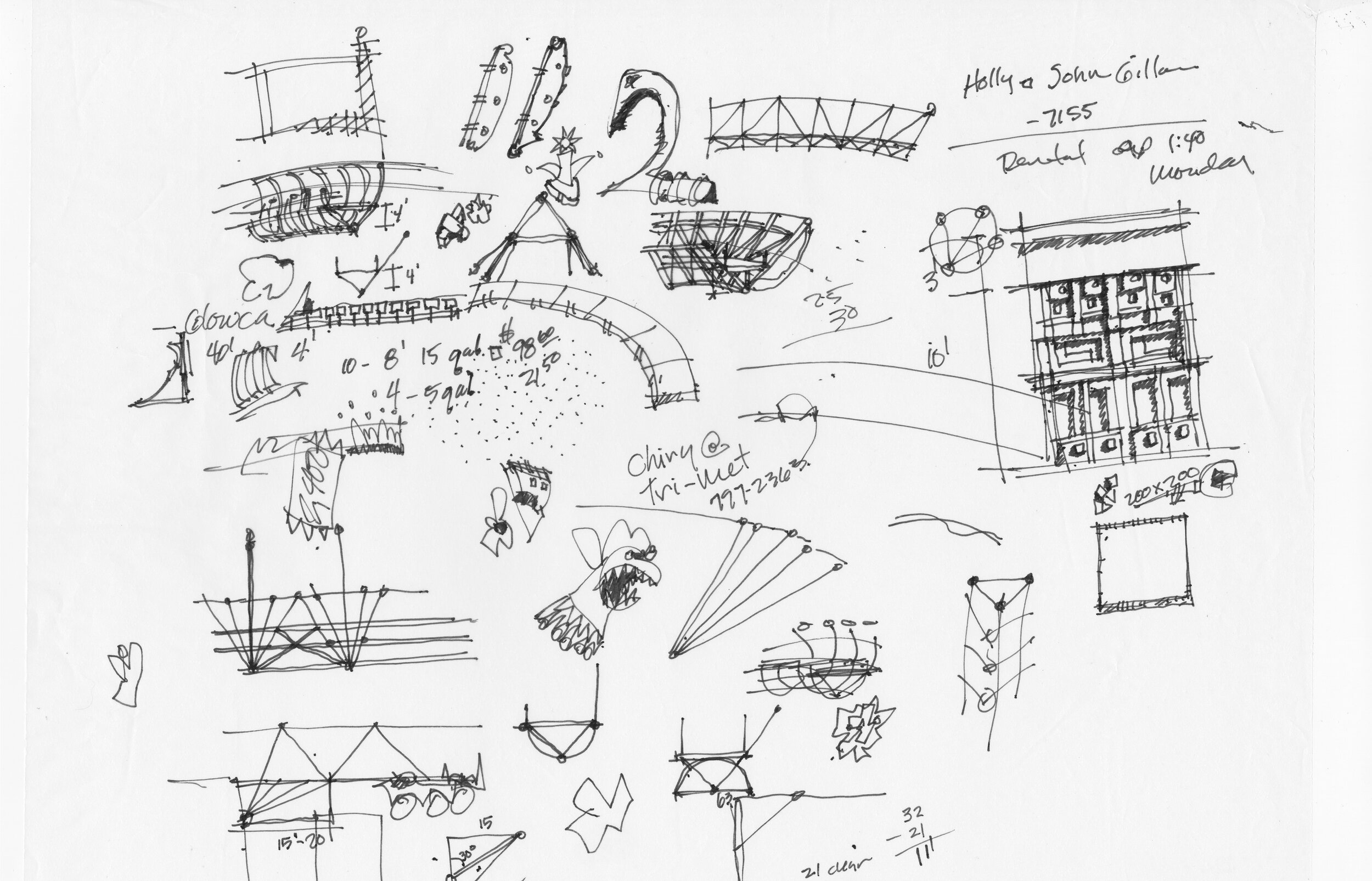
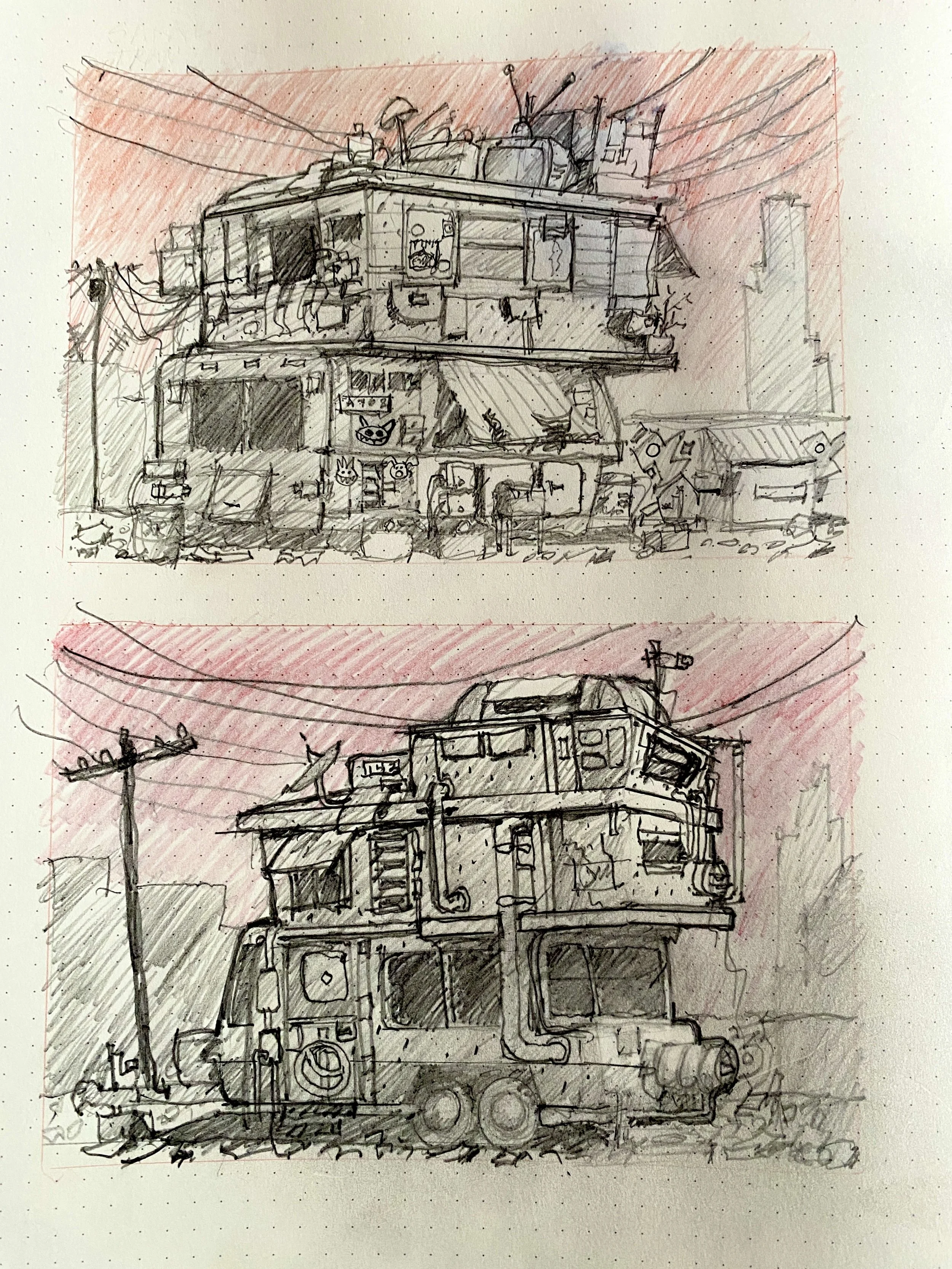
Second, I keep sketchbooks. They are wonderful tools for quickly getting down ideas before they evaporate. I draw, paint, tape images or doodles and write my ideation. I like unruly sketchbooks.
Third, art is an exploration and invention of stories, imagined places and atmospheres. Therefore, my tools are whatever fits my mood or my artistic needs. Art, for me, is meditation, a continuum, and a flow of ideas, expressions and interpretations of uncommon landscapes, places and feelings.
Art is a lifetime journey of discovery and is a personal endeavor. Often artists collaborate to achieve a common goal and common work. But for individual artists, and for coastal artists in particular, preferred tools and explorations are a personal choice. Growing up with Walt Disney characters and cartoons dancing around in my head, I always thought that it was all about illustration. But later in life I found that Disney was more about the story than the illustrations he and his team brought to life on the big screen. So, I would recommend identifying a storyline. It can always change, but like with Disney, the story can become the armature upon which to hang exciting images of the mind.
Lloyd Lindley II
lloyd_lindley_ii @instagram

The Power of Ideas: Past, Present, & Future
Why do we create?
What is creativity?
How do we create? And;
Where do ideas come from?
Consciously or unconsciously, these are the questions creators constantly ask themselves. At one time left brain and right brain people, those that are linear and those that are nonlinear, lived in two separate pigeonholes. Left brainers were accountants, A to Z processers, and astrophysicists working the columns and lines to make sense of nonlinear worlds. Right brainers, designers, philosophers, nomads and artists think and worked freely, cognitive wanderers, living in an infinite universe of wonder and what’s next.
Casual observation, and older age, shows that no one pigeonhole is unescapable. In fact, there is tremendous crossover for many. And, while creativity and accounting potentially produce jailable conflicts, the boundless opportunities of both hemispheres provide an exciting playground for free thinkers. It’s like an accountant owning and driving a race car. The left hemisphere provides the means. The right hemisphere exercises dynamic, even dangerous, nonlinear thinking and reactions to everchanging curves and chicanery from track to track. Think of a pigeon flying at high speed through a cobweb of tree branches and landing on that one special branch. Perhaps what, why, how and where, is not so much about the pigeonhole or destination, but more about the experiences in the solitude of deserts and forests.
Where do ideas come from? A tromp in the woods, twigs snap, trees groan and birds titter jumping from branch to branch, creates an uncluttered microcosm for thought or ideation. Walking through unfamiliar ruins of past civilizations, remnants of exstinct and lingering cultures prompt questions. The surrealist, Andre’ Breton, originator of automatism, “the dictation of thought in the absence of all control,” suggests automeditation - the cognitive walk in the woods. It is the place where ideas and creative thoughts manifest. It is ideation where “if then”, becomes “what”.
Throughout millennia, archetypal forms, squares, cubes, pyramids, rectangles, circles and spheres have defined places for people. They are the fundamental building blocks of individuality and civilization. As an example, traveling among the piles of stone in southern Mexico, Guatemala, Peru, and other far reaches of the planet, I felt the presence of the creative cultures that built more than shelter for survival. Similarities between cultures are uncanny. Universal fundamentals of civic development such as mathematics, geometry, cosmic positioning, centers, neighborhoods, connections and symbolism are as old as Gobekli Tepe in Turkey at over 10,000 years.
Universal cultural principles also apply to the built environment. The form of the city, village, and community, and their structures express cultural characteristics and social behaviors of their people. Expression of basic individual cultural principles of security, safety, religion, political hierarchy, agriculture, manufacturing and trade are central. Differences manifest not in the “what” but in the “how” each culture imagines and creates a reflective civic form.
Creation is the sum of ideas, inspiration and process. A blend of linear and nonlinear thinking including automeditation, exploration and rich experiences. Abandon the pigeonhole, adventure in unfamiliar places, look for new ways, and always ask why, what and how does the world work. That is the beginning. The end will find itself.
The role of creativity and ideation play to the types, forms and symbolic expressions of people and communities.