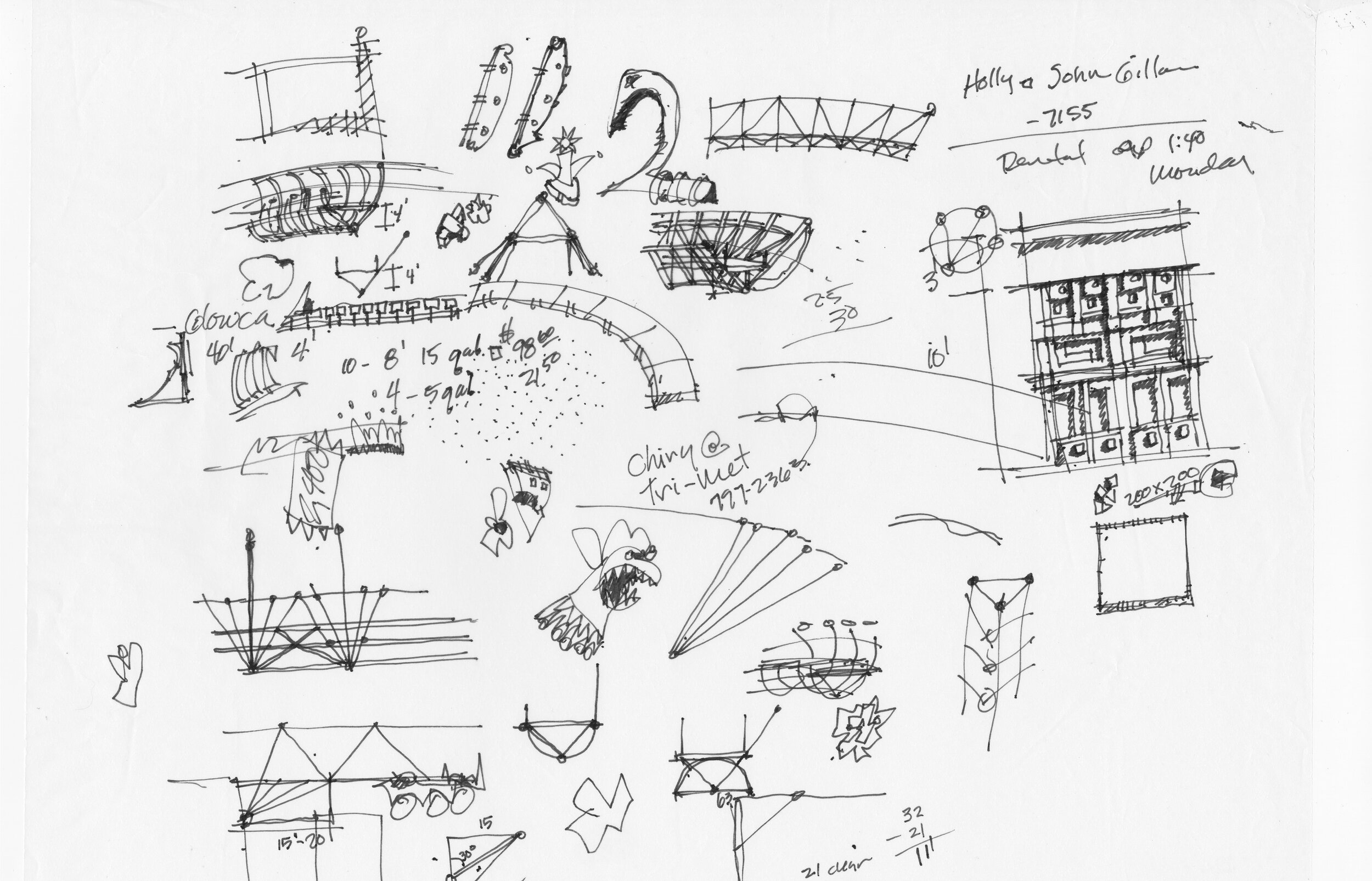
CREATIVE PROCESS
Ideas are everywhere, in conversations, books, museums, beach walks and dreams. Translating ideas into shared images enables us to understand each other better and to express ourselves as individuals to our greater community.
The Infinite Mind
Moments of contemplation over coffee or stars helps manifest ideas in the mind, some would say in the third eye, “a ‘meta’ organ that consists of your mind and all of your senses working together as a larger, more powerful sensory organ,” Casey Kochmer, Opening the Third Eye. Magnesium Studio is about ideas and stories told through abstract surrealism. The studio harvests ideas, transforming them into images for others to learn from, react to, or simply enjoy. The process is contemplative where works are approached as meditations, blending intentional constructs with spontaneous composition of line and color to form symbolic images of depth and substance.
The Creative Mind
“If you believe human wants and needs are infinite,” said Andreesen, “then there are infinite industries to be created, infinite businesses to be started and infinite jobs to be done, and the only limiting factor is human imagination. The world is flattening and rising at the same time.”
“The World is Flat, “America and Free Trade”, page 231 Thomas Friedman, 2005
Within a lifetime the average person uses about one tenth of one per cent of the human brain’s capacity to store information and solve complex problems. The creative mind is a restless thing, always searching or wondering through the labyrinth of a mental entourage of places and objects that may hold the promise of the next great idea. Someone once said, “there are no new ideas, just a continuum of recombined and repackaged past ideas.” Where do new ideas come from? How can new ideas be found? How can the creative mind tap the vastness of the human brain to unlock and access the seemingly unlimited capacity and capability of an exploitable resource that we are all born with? Or are we all born with a creative mind?
In 1969 I stood before my third grade class and shared a vision for a small world I was creating on the wooded banks of a stagnant slew near Eugene, Oregon. My “show and tell” was all tell and realistically there was no show involved. But in my mind the world that I was creating with my friends was very real. While the tree house and other tree top platforms were in place, an entire master plan of bridges, paths vehicles and buildings were so vivid in my mind they had become my reality. Looking back, my teacher, while working with limited tangible information, was patient and allowed me to go on with my vision to an unbelieving classroom. However, I had invited enough of my classmates to the “fort” that I was able to preserve any credibility I had especially considering that I was nine years old. I can only imagine little Roald Dahl, Salvador Dali or Raymond Lowey describing weekend or summer activities to Monday morning classmates.
Robert Kostka, a protégé of Moholy Nagy, Josef Albers and Peter Selz of the New Bauhaus school of design in Chicago said, “we spend our entire childhood desperately trying to become adults and the rest of our lives trying to get back to our childhood.” His point was that by having the freedom of childhood thought enables unencumbered creative thinking. It is the simple ability to play that unlocks the endless possibilities of problem solving. Unlike mathematics, there can be endless answers to design problems. Finding a solution is much less important than finding the best solution to any design problem. Having the mental freedom to explore and play with possibilities can produce extraordinary results.
“When I asked Bill Gates about the supposed American education advantage – an education that stresses creativity, note rote learning – he was utterly dismissive. In his view, those who think that the more rote learning systems of China and Japan cant’t turn out innovations who can caompete with Americans are sadly mistaken. Said Gates, “I have never met a guy who dosen’t know how to multiply who created software… Who has the most creative video games in the world? Japan! I never met these rote people’ … Some of my best software developers are Japanese.”
“The World is Flat, “Dirty Little Secret #2: The Ambition Gap”, page 264, Thomas Friedman, 2005
Today, there is an unavoidable trap that many designers fall into. The trap of not designing but applying standards, standard details, standard systems, standard materials and standard everything leads to mediocre everything. Rarely does film, architecture, engineering, industrial design, graphic arts (clip art) fashion, planning, urban design and medical stuff produced from standards lead to the advancement of technology or the advancement of thought. Space exploration probably led to the greatest thinking and innovation since the industrial revolution maybe even since the Roman arch.
There is a fine line between innovation and creative design and free thinking where deadlines and clearly defined problems or needs are less important than creating a specific solution to a specific problem.
“At an early age children are weaned on the marvelous, and later on they fail to retain sufficient virginity of mind to thoroughly enjoy fairy tales.”
The Process
Life Experineces
Expressionist Surrealism
Symbolism
Color
Triad Concept
Story Line
Media
Meditation
